Dartmouth College offered admission to 1,749 students for the Class of 2025 for an overall acceptance rate of 6.17 percent, down from last year's 8.79 percent. Last year Dartmouth College extended offers of admission to 1,881 applicants for its Class of 2024. The Class of 2025 saw an increase in applications of 33 percent over last year's record applicant pool with applications jumping up from 21,394 to 28,357. This follows the implementation of a test-optional admissions policy due to pandemic-related testing difficulties. The total number of accepted students to the Class of 2025 includes the 591 admitted through the early decision process in December. Last year, Dartmouth College offered early admission to 574 students in December.
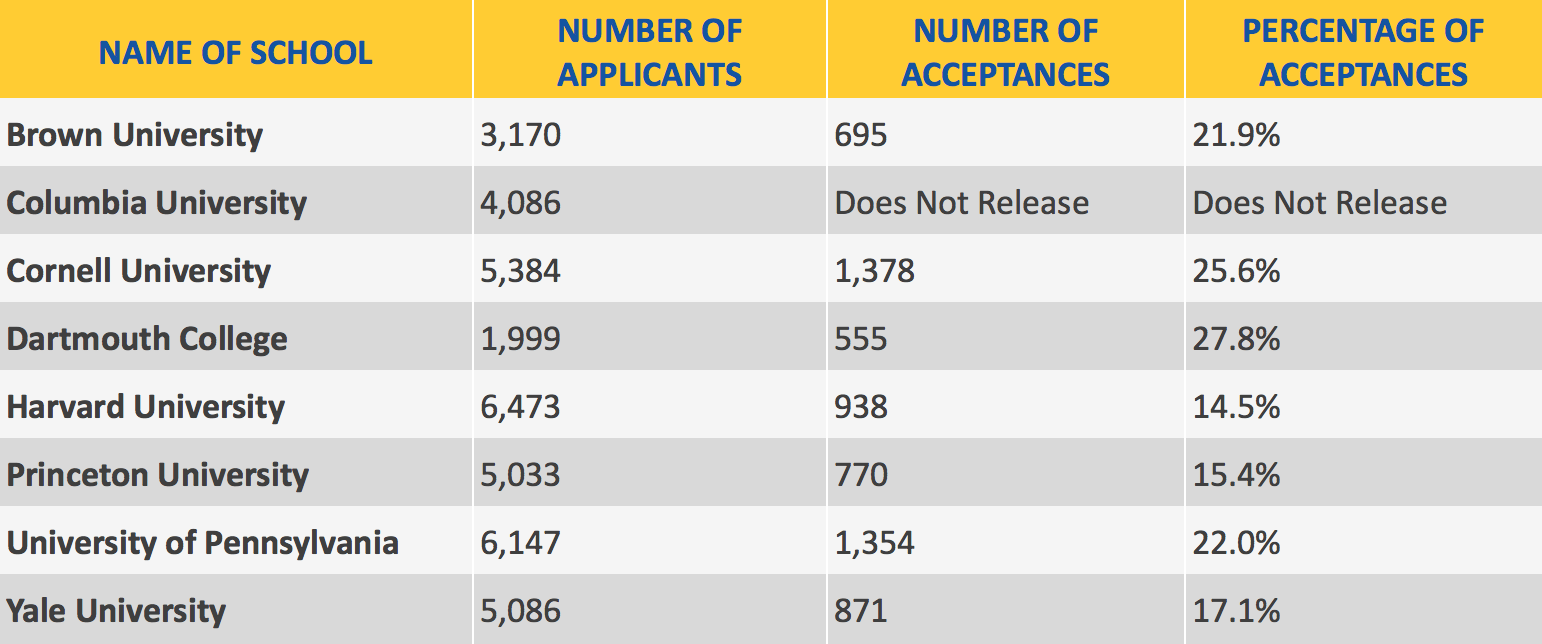
Brown University offered admission to 5.45 percent of its applicants to the Class of 2025, down from last year's acceptance rate of 6.88 percent for the Class of 2024. Out of the 46,568 students who applied—the largest pool in University history —2,537 students were admitted. The 1,652 students accepted through the regular decision process joined the 885 students admitted in December. The rate of admission for the ED round stood at just below 16 percent.

Last year, Brown offered admission to 6.88 percent of its applicants to the Class of 2024, up from the previous year's acceptance rate of 6.60 percent. For the Class of 2024, 36,794 students applied and 2,533 students were admitted with 800 students admitted in December for a rate of admission for the ED round of 17.54 percent. This year, Harvard received a total of 57,435 applications compared to 40,248 for the Class of 2024.

With 1,968 admitted students to the Class of 2025, the rate of admission decreased from 4.92 percent to just 3.43 percent for the combined SCEA and regular decision. In the early round, Harvard University received 10,086 applications and accepted 747 for an admit rate of 7.41 percent, down from 13.93 percent the previous year. Harvard's SCEA admit rate is substantially higher than the regular decision acceptance rate of 2.58 percent. Last year, Harvard received a total of 40,248 applications compared to 43,330 for the Class of 2023. With 1,980 admitted students to the Class of 2024, the rate of admission increased from 4.50 to 4.92 percent for the combined SCEA and regular decision. Also, for the Class of 2024's early round, Harvard University received 6,424 applications and accepted 865 for an admit rate of 13.93 percent.

Of the 56,333 students who applied to Penn's Class of 2025 in the early and regular rounds, 3,202 were admitted, leading to an overall acceptance rate of 5.68 percent. The 3,202 admitted students to the Class of 2025 included 1,194 students who were admitted through the early decision round. The admission rate for the ED round was 15 percent out of 7,962 applicants. Last year, 42,205 students applied to Penn's Class of 2024 in the early and regular rounds and 3,404 were admitted, leading to an overall acceptance rate of 8.07 percent. Out of the total 3,404 admitted to the Class of 2024, 1,269 students were admitted through the early decision round. The admission rate for the ED round was 19.67 percent out of 6,453 applicants.

For the Class of 2023, 44,960 students applied to in the early and regular rounds and 3,345 were admitted, leading to an overall acceptance rate of 7.44 percent. For the Class of 2025, Columbia accepted 2,218 students from 60,551 applications, a 51 percent increase from last year. The acceptance rate of 3.66 percent is below last year's 6.15 percent when Columbia admitted 2,465 applicants from 40,084 applications. For this admission cycle, we estimate that Columbia received 6,435 early decision applications and accepted 650 students for an admission rate just above 10 percent. It was an unprecedented year across the Ivy League with all Ivy League institutions dropping the SAT / ACT admissions requirement due to the ongoing global pandemic.
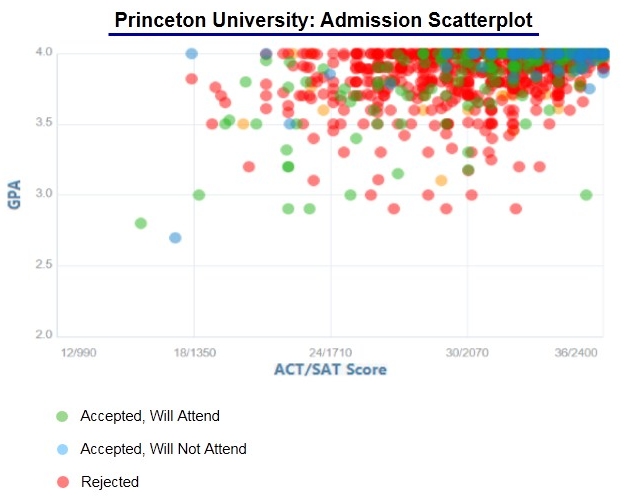
The relaxed requirements led to a surge in applications to our nation's elite universities with so many students — students we've deemed Squeakers — submitting applications without test scores. In the Early Decision round at Brown University, a record-low 15.9% of applicants to Brown's Class of 2025 earned admission. In all, 885 students were offered admission under Brown's binding policy out of an applicant pool of 5,540 students.

The number of Early Decision admits as well as the number of Regular Decision applicants were both records for the Providence, Rhode Island-based institution. So the trend of top schools getting more competitive is still evident after COVID. Certain schools are highlighting slight differences in regards to the percentage of admits that applied with a test score compared to applicants who didn't. Students should certainly take the standardized tests if they are able to, but the differences in admissions numbers aren't significant enough for students to worry unduly about access to SAT/ACT testing. Wall Street Journal is quoted saying, "The University of Pennsylvania admitted 15% of those who applied in its binding early-decision round.

While about two-thirds of the applications included test scores, three-quarters of those admitted did". Author Jeff Selingo has also mentioned that in his conversations with other admissions officers, they highlight a slight difference within ED applications as well, specifically mentioning numbers for Emory, Colgate, Georgia Tech, and Emory. The low acceptance rates of highly selective schools tend to dominate the admissions conversation and the curiosity of applicants. These tendencies can obscure a higher schooler's perspective of the college admissions process. In reality, the vast majority of colleges and universities have decently high acceptance rates. 15,036 students applied in the EA round — a tremendous 62% from last year's early action period!

This prestigious STEM-focused college offered admission to 719 students. This is approximately the same as the number of students admitted in the early round last year. However, due to the incredible increase in application numbers, the acceptance rate went down from 7.4% to a brutal 4.8%. It's undeniable that ED increases a student's chances of acceptance; Brown University, notably, accepted nearly 16% of its Early Decision applicants into the Class of 2025, compared to its overall Class of 2025 acceptance rate of 5.4%. Early Decision applications, being binding, also boost colleges' yield rates , which colleges highly value.
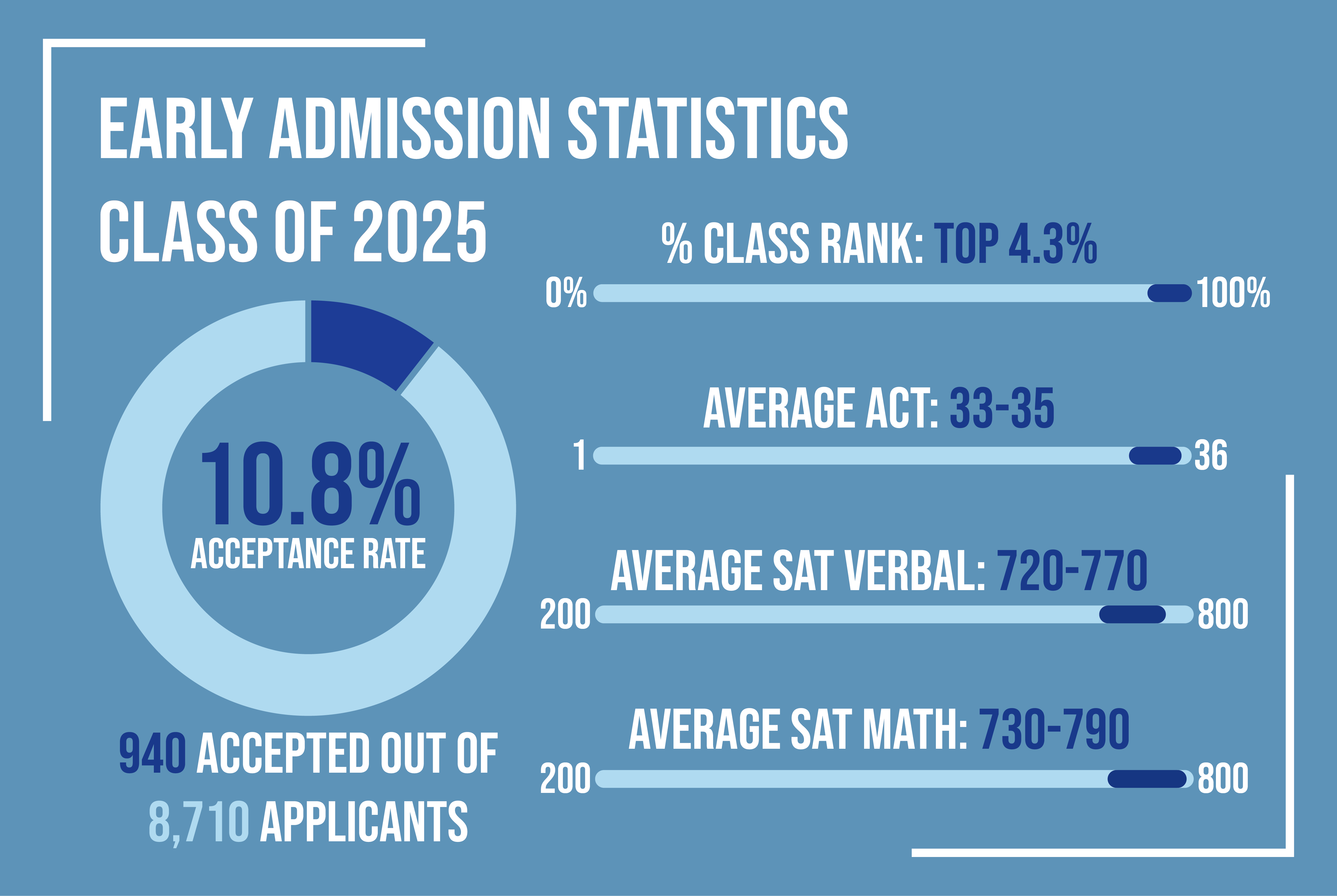
Penn saw a 23% increase in their ED applicants this year, and their admit rate dropped to a record-low 15% (compared to 19.7% last year). In addition to actually admitting that going test-optional was a factor in the increase, Penn gave us useful data in determining how test-optional policies affected ED admissions decisions. 38% of ED applicants didn't submit scores, and 24% of admitted students didn't submit scores.

Based on those numbers, we are able to calculate admit rates for students who submitted scores and who did not. "There's a widespread perception that applying ED puts students at a disadvantage for financial aid. That may be the case at schools with limited resources, because they know accepted students are committed to coming, so the college could short them on financial aid.

But like everything else in the admissions game, there is no hard and fast rule. At least one study on ed found just the opposite — that financial aid is more generous for Early Decision students because schools sometimes run out of money for regular decision admits". Admissions office received a record 7,939 applications in the early action round — an increase of 38% over last year. 50% of students who applied through the restricted early action option were deferred. Overall applications to Columbia University's Class of 2025 skyrocketed 51%.
In all, between Early Decision and Regular Decision, 60,551 students applied to Columbia's Class of 2025. The overall admit rate for the Class of 2025 thus dropped to an all-time low of 3.66%. In the Early Decision round, applications soared by a margin of 49%. To put Columbia's record-setting 60,551 applications in historical perspective, for the Class of 2024, 40,084 students applied and the admission rate stood at 6.1%. For Columbia's Class of 2023, a then-record 42,569 students applied and the admission rate stood at a then-record low 5.1%. Prior to the Columbia Class of 2023, total applications never reached 41,000 and the admission rate never dipped below 5.5%.
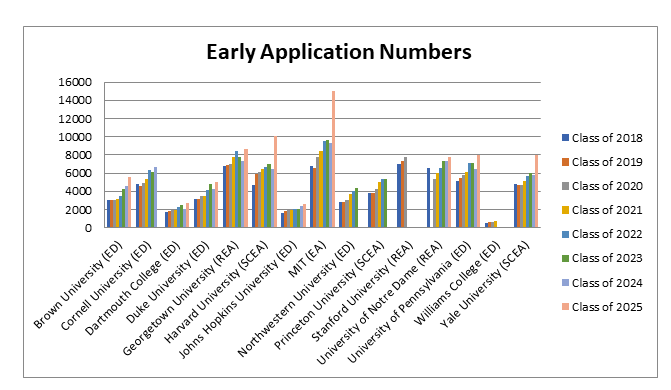
Some colleges — such as Stanford, Harvard, Princeton, and Yale — practice Restrictive Early Action (also known as Single-Choice Early Action). In Restrictive Early Action , applicants are allowed to apply to only one private college under Early Action. One quick look at the Class of 2025 admissions is enough to make you wonder why college acceptance rates are so low. Sure, there are many colleges that accept a fairly large percentage of students, but the majority deny the overwhelming majority of applicants. Some of the most popular schools, such as the Ivy League institutions, are among the most selective. Accepted a record-low 15% of early decision applicants to the Class of 2025.

This year, 7,962 students applied through the binding early decision program—a 23% increase from last year's 6,453 applicants. The college has stated that these students will comprise about half of the Class of 2025. In this way, REA allows students to demonstrate exclusive interest to their top-choice college while also retaining flexibility in choosing among their college offers. REA applicants thus benefit from higher acceptance rates, similar to those for Early Decision applicants.

Even if a student is accepted in the REA round, they have until May to choose whether or not to commit—the same timing as Regular Decision. Because of this, REA is especially useful for students who, before committing, want to first compare and consider the different financial aid packages that colleges may offer in both the REA and Regular Decision round. Due to higher rates of deferral than usual for the Class of 2024, many applicants are wondering how this will affect admissions for the Class of 2025. For example, 20% of this year's freshmen deferred enrollment at Harvard, and Penn and Yale also reported record high gap years for the Class of 2024. Jeffrey Selingo, a former editor of The Chronicle of Higher Education, predicts that colleges will actually accept more students from the Class of 2025 and accept more transfer students to the Class of 2024, if possible.

He points to the fact that college budgets have suffered during this time and schools need the tuition revenue. UPenn received 7,962 applications in Early Decision and 48,371 in Regular Decision . This means admissions accepted 15% of Early Decision applicants and just 2.5% of Regular Decision applicants, resulting in an overall acceptance rate of 4.26% for 2021.

This would effectively mean that the early boost, and Tulane's actual selectivity, is not what it seems. Now that admissions results are in for the Class of 2025, it's clear that applications to Ivy League schools surged in the most recent application cycle, with nearly 100,000 more students applying than the year before. Unsurprisingly, acceptance rates for the Class of 2025 are historically low. There's a common misconception that a school's acceptance rate is a direct reflection of the quality of education it provides. In this line of thinking, a school that admits just 3% of applicants is better than an institution that admits 33% of students. The root of this myth is that most well-known schools have low acceptance rates.

Last year, MIT accepted 687 students for an acceptance rate of 7.39 percent. The University of Pennsylvania received 7,962 early decision applications for the Class of 2025 and reported an increase from last year's 6,453 early decision applications. Penn admitted 1,194 students under the Early Decision program for a 15 percent admit rate. Of those students admitted in the Early round to Brown, 48% identified as students of color — yet another new benchmark and up from 44% last year. 16% will be the first in their immediate families to attend college, down from 17% last year.

And 59% of admits applied for financial aid, down from 62% last year. 19 students earned admission to the Program in Liberal Medical Education, marking a 10% Early Decision admit rate for PLME. After many colleges reported all-time low acceptance rates, some students might be curious about their yield rates, or just how many of these admitted applicants have chosen to enroll. Yield is a priority for every college because it impacts their place on rankings lists and it can also influence their bond ratings. The home of the Blue Devils accepted the lowest percentage of ED applicants in its history—admitting 840 out of 5,036 students, resulting in a 16.7% acceptance rate. 59% students applied for financial aid, while 16% of admitted students are first-generation.

Within the admitted group, 48% are students of color, including students who self-identify as Black, Latinx, Native American, Native Hawaiian or Pacific Islander, or Asian — a 8% increase from last year. As a result, many students may have much longer college lists this year compared to previous admissions cycles, which may have contributed to the significant increase in applications. More and more people are applying to college, but schools aren't expanding at an equal pace, driving down already low acceptance rates even lower.

Despite the increasing number of applicants, many schools are maintaining their current freshman class sizes. Although the acceptance rates for the Class of 2025 admissions represent all of the talented students that got accepted, the remaining percentage is comprised of students that were either waitlisted or outright denied. TheMassachusetts Institute of Technology admitted 1,340 students out of 33,240 applicants for the Class of 2025 for an acceptance rate of 4.03 percent.

In its early round, MIT admitted 719 students out of 15,036 applications, yielding 4.78 percent which is also the lowest rate of acceptance in an early round among its peer group composed of the Ivy League and Stanford. Last year, MIT admitted 1,457 students out of 20,075 applicants to the Class of 2024 for an acceptance rate of 7.26 percent. In its early round, MIT admitted 687 students out of 9,291 applications, yielding an admission rate of 7.39 percent. In the previous year, the school admitted 1,410 students out of 21,312 applicants to the Class of 2023 for an acceptance rate of 6.62 percent. In the 2023 early round, MIT admitted 707 students out of 9,600 applications.

Among this year's admitted early decision students, 59% applied for financial aid, and 16% of students will be first in their family to attend college. Within the cohort, 48% are students of color, defined as those who self-identify as Black, Latinx, Native American, Native Hawaiian or Pacific Islander, or Asian — a 8% increase from last year. First-generation college students represent 20.7 percent of the admitted class, up from 19.4 percent last year, and about 20.4 percent of those admitted qualify for federal Pell grants . Women account for 52.9 percent of the total class, and international students comprise 12.2 percent.

When reviewing yield rates, it's important to also pay attention to what we didn't see right away. Namely, many colleges took months to release their yield rates because they were still crunching the numbers and admitting students off of their waitlists to round out their freshmen class. Given all of the uncertainty caused by the COVID-19 pandemic and disruptions to the admissions process, many schools also had longer waitlists than they did during previous years. As test date after test date had to be cancelled, over 500 colleges switched to a test-optional policy this year.

Many students were only able to take the SAT or ACT once, if at all. This leaves students at the disadvantage of being unable to use super-scoring and wondering if test-optional really means test-optional. However, know that if you do submit scores, the college will review and consider them. Also, college admissions will be relying on high school grades more heavily this year. Penn reported that 38% of all their ED applicants chose not to include test scores, and of those admitted, 24% did not submit test scores. 37,852 students applied Regular Decision of which 2166 students were admitted from that regular decision pool as well as from deferred early decision applicants.

Upenn Early Decision Acceptance Rate Though the adjusted Early Decision admit rate of 14.3% still seems more favorable than the 6.9% Regular Decision admit rate, they are separated by only 7.3%. Because the number of non-recruited admits who actually get accepted in Early Decision is so small , that 7.3% difference equates to just 30 non-recruited students who got the "early decision" boost and got in. For context, a data table that used to be on Brown's Admissions Factswebpage showed that Brown's 10 most recent admissions classes have a mean size of 2,785 admits and a standard deviation of 108 admits from year to year.

In simple language, that means the overall number of students admitted into each class naturally fluctuates, at times, to a much greater degree than 30 students, giving the Early Decision boost no significance. Now, Brown's official stance that applying early doesn't increase your odds of success begins to make sense. MIT received 15,036 early admission applications, an outrageous 62% increase from last year's early admission cycle. By admitting 719 applicants, MIT's early admit rate was a minuscule 4.8% compared to last year's 7.4%. MIT deferred 70.8% of applicants, a number that, while extremely high, fits in line with their deferral percentage from recent years. However, the difference between the two types of acceptance rates fell at Harvard, where only 7.4% of early action applicants received an offer of admission.

In fact, the US Department of Education notes that four-year colleges across the country accept over 66% of first-year applicants on average. It's perfectly natural for people to focus on either end of the extreme in the form of uber-selective schools and near-100% acceptance rates. At Yale University, between the Early Action and Regular Decision rounds, total applications soared 33%. 46,905 students submitted applications — 7,939 in Early Action and 38,966 in Regular Decision . Overall, 4.62% of students earned admission to Yale's Class of 2025. To put these figures in historical perspective, 35,220 students applied and the admission rate stood at 6.5% for Yale's Class of 2024.


No comments:
Post a Comment
Note: Only a member of this blog may post a comment.